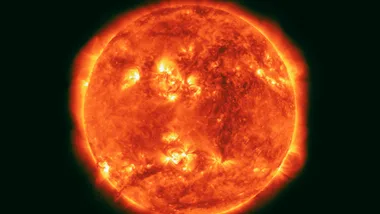

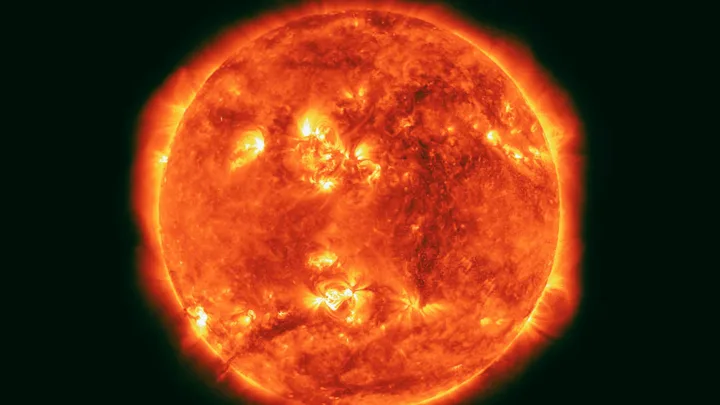
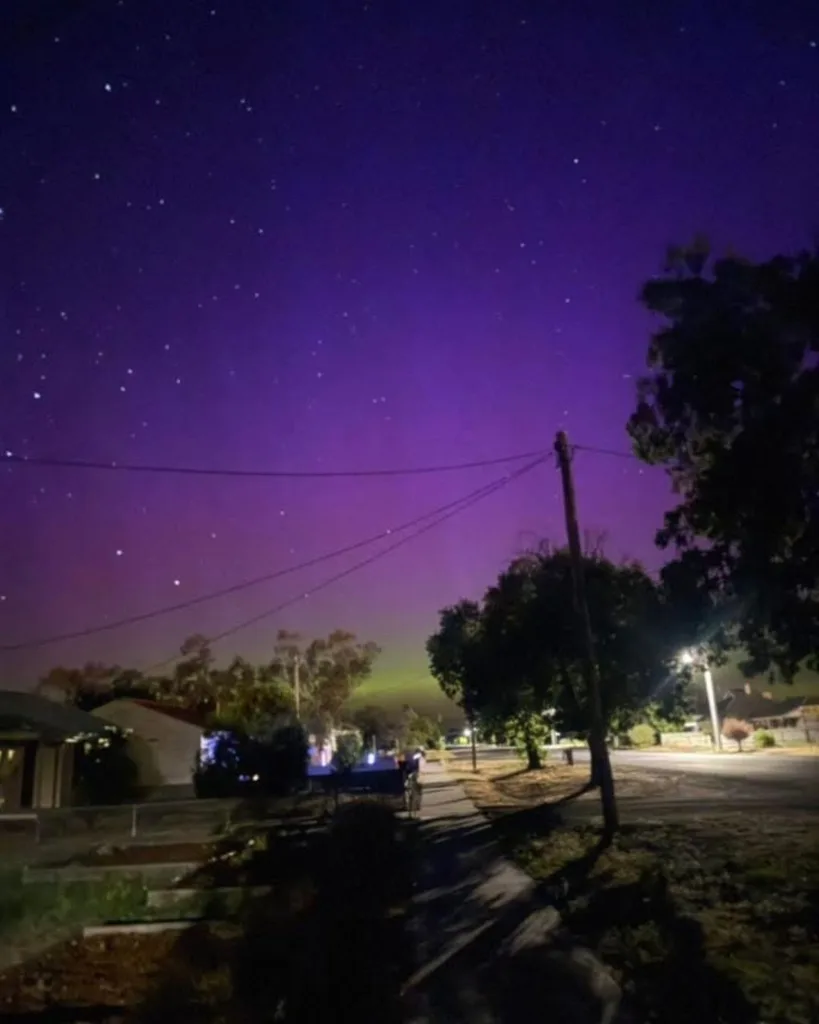
This week, NASA’s Solar Dynamics Observatory observed a strong solar flare on February 4 — just weeks after severe solar flares triggered the largest geomagnetic storm we’ve seen in two decades. The January event sent a swathe of auroras dancing across the country, from Tasmania to Queensland, in a display that rivalled the infamous Halloween storms of 2003. That particular cosmic outburst caused power outages across Sweden and transformer damage in South Africa, along with spectacular auroras visible across both hemispheres, while this one lit up suburbs across Australia that are usually left in the dark during aurora events.
We’ve become increasingly enchanted with the phenomenon that is the borealis over the last year, and it seems like they’re becoming more frequent. So, is a solar flare an indicator that we can expect another aurora display soon? And what exactly are they?
We took a deep dive into the science of solar flares and how we can use these cosmic outbursts to predict when we might see the Aurora Australis next.
What Exactly Is A Solar Flare?
A solar flare is what happens when the magnetic energy of the Sun reaches its breaking point: a massive explosion that erupts from the Sun’s surface, hurling radiation across the solar system.
These eruptions occur when magnetic fields near sunspots (those dark patches visible on the Sun’s surface) become so twisted and tangled that they snap back, releasing enormous amounts of energy. Solar flares span the electromagnetic spectrum — from X-rays and gamma rays to radio waves and ultraviolet light — making them the most powerful explosions in our solar system. According to NASA, the biggest ones can pack as much energy as a billion hydrogen bombs.
Dr. Kate Brand, Manager of Space Weather and Spaceflight Operations at the Bureau of Meteorology, explains that a solar flare is “a burst of radiation from the Sun, primarily UV and X-ray radiation. These travel at the speed of light and have the potential to impact technologies such as high-frequency radio communication.”
Not all solar flares are created equal. Scientists use a classification scale similar to the Richter scale for earthquakes, ranking them from A (the weakest) through B, C, M, and up to X-class flares — the heavyweights. The flare that occurred during January’s event was rated X1.9, placing it firmly in the upper tier of solar outbursts. These X-class flares are the most intense and least common, capable of disrupting radio communications and triggering radiation storms in Earth’s upper atmosphere.
Crucially though, solar flares and auroras aren’t directly connected. A solar flare is a burst of light and radiation that reaches Earth in just eight minutes, travelling at the speed of light. But a solar flare can often be an indication that an aurora might occur, because it frequently coincides with something else entirely—a coronal mass ejection.
What Is A Coronal Mass Ejection?
Enter the coronal mass ejection, or CME — the real aurora-maker.
Dr. Brand describes it as “a huge eruption of charged particles from the Sun that heads out into space.” Unlike a solar flare’s burst of radiation, a CME is physical matter being ejected—billions of tons of solar plasma blasted into space.
Think of it this way: if a solar flare is like a camera flash — a brilliant burst of light — then a CME is a physical mass being thrown, an enormous cloud of charged particles hurtling at speeds of up to 2,000 kilometres per second. Crucially, while solar flares reach us in minutes, CMEs take one to three days to arrive. That’s your warning time.
“A CME can head in any direction into space,” Dr. Brand explains. “If it heads toward Earth, it can result in a geomagnetic storm that has the potential to impact technologies such as satellites, the power network, and high-frequency (HF) radio communications. Along with these impacts, a geomagnetic storm can also lead to beautiful auroras.”
Strong solar flares and CMEs often occur together, triggered by the same magnetic mayhem on the Sun’s surface. It’s the slow-moving CME — not the fast-moving flare — that creates the auroras we chase. But because they’re usually paired, a visible solar flare has become associated with upcoming auroras, even though the flare itself isn’t what creates them.
How Do CMEs Cause The Aurora Australis?
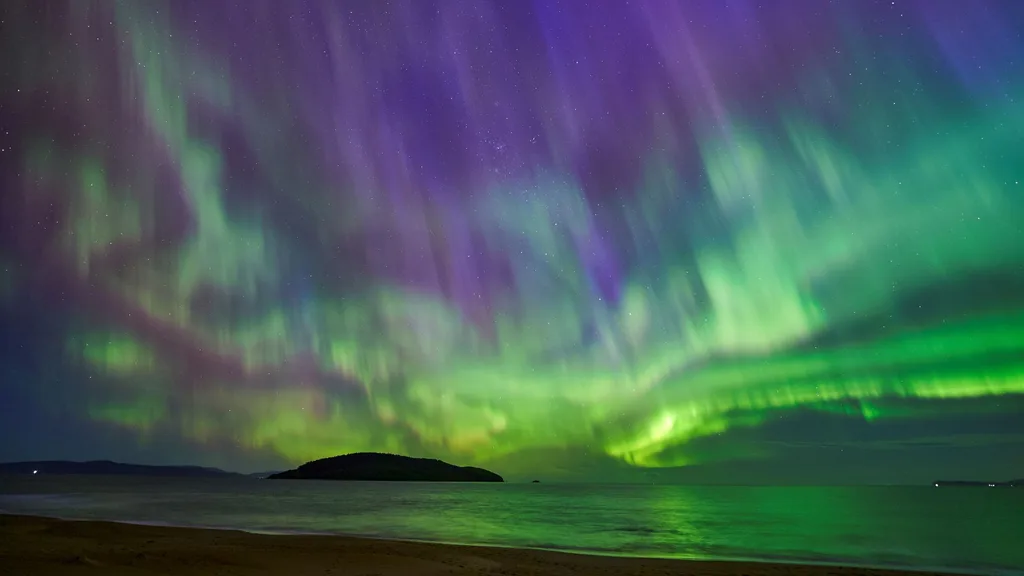
Here’s where science becomes spectacular. “It can take several days for the coronal mass ejection to reach Earth,” Dr Ryan French, a solar physicist at the University of Colorado Boulder, explains, “but when it does, it slams into Earth’s magnetic field and high-energy particles will enter our magnetic field. They will then slide down towards the North and South Poles, and those particles will collide with the air in our atmosphere and cause the atmosphere to glow.”
“The different colours you see in the aurora are caused by different elements at different heights being smacked by these high-energy particles from space,” Dr. French notes. The colours depend on which gas is being excited and at what altitude. Oxygen produces those vivid greens and occasional reds that dominated Instagram feeds in January, while nitrogen creates the ethereal blues and violets and lilacs that had everyone abandoning their couches for a glimpse of the spectacle.
The stronger the solar activity, the further from the poles these light shows can be seen, which is why people as far north as NSW and even Queensland caught a glimpse of January’s display.
The intensity of the geomagnetic storm is crucial. When forecasters talk about G1 through G5 storms, they’re describing how much Earth’s magnetic field is being disturbed. The recent January event reached G4 (severe) levels, which is why the aurora was visible so far north and appeared so brilliant. During a G4 storm, the aurora oval — the ring around the magnetic pole where auroras typically occur — expands dramatically, giving more people the chance to witness the phenomenon.
Understanding Space Weather
Dr. Brand’s work at the Bureau of Meteorology’s Australian Space Weather Forecasting Centre (ASWFC), the official source of space weather forecasts, alerts and warnings in Australia, involves monitoring exactly these kinds of events.
“Space weather primarily refers to events on the Sun that have the potential to impact technology on Earth and in near-Earth space (the part of space where satellites orbit),” she explains. “Occasionally, the Sun erupts charged particles (solar plasma) or solar radiation that can head towards Earth. Space weather can take anywhere from 8 minutes to several days to arrive at Earth, depending on the type of space weather event.”
This is why space weather forecasters monitor the Sun 24/7, issuing forecasts, warnings and alerts to report on space weather activity. When they spot a strong solar flare, they know a CME might be coming — and if it’s Earth-directed, Australians might want to grab their cameras and head south.
Can We See Solar Flares And CMEs In Australia?
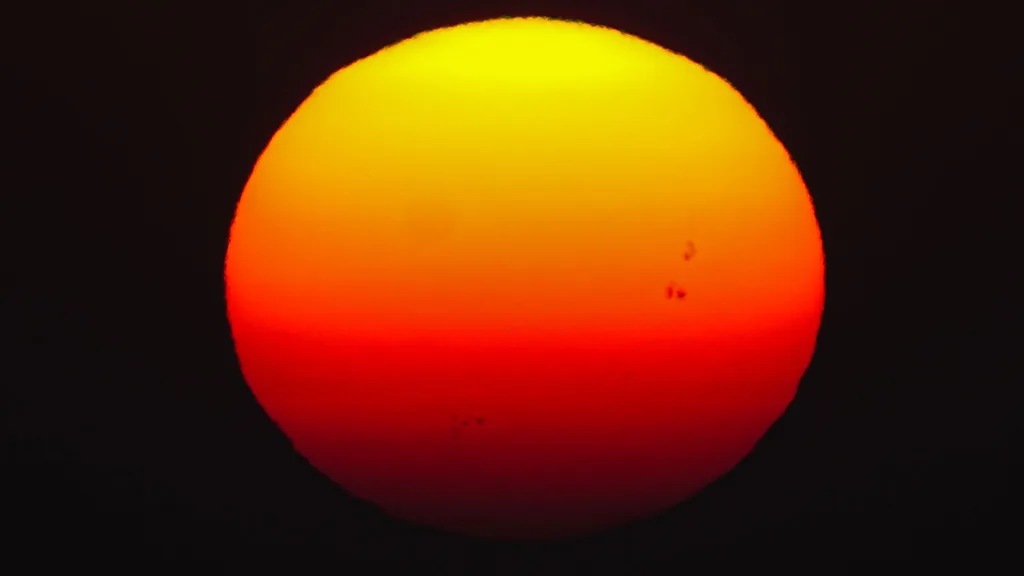
You can’t actually see solar flares or CMEs from Earth. Solar flares emit radiation in wavelengths (X-rays, gamma rays) that our atmosphere thankfully filters out. CMEs are clouds of plasma that are invisible to the naked eye, they require specialised space-based instruments to observe.
What we can see are the results, specifically, the auroras that occur when a CME reaches Earth and its charged particles interact with our atmosphere. These are the Northern and Southern Lights that appear across the world after a CME arrival.
But Australia tends to get less of a show than countries like Iceland and Norway, where the stunning Northern Lights are common enough to be a tourist attraction. There’s a very good reason for this, and it has nothing to do with the aurora itself.
The Aurora Australis and Aurora Borealis are actually mirror images of each other. When one hemisphere’s aurora lights up, the other does too, with roughly the same intensity and colours. They’re powered by the exact same solar events happening at the exact same time. So scientifically speaking, they’re equally spectacular.
Dr. Brand confirms this: “Generally, if the Aurora Borealis (in the northern hemisphere) is visible, the Aurora Australis (in the southern hemisphere) will be too, but there’s much more populated landmass near the north pole than the south pole. Antarctica and Tasmania tend to see auroras somewhat frequently.”
The problem is geography. The Northern Hemisphere has a massive advantage: there’s simply more land closer to the North Pole, and crucially, that land is inhabited. Countries like Iceland, Norway, Finland, Sweden, Canada, and American states like Alaska all sit comfortably within or near the auroral oval — the ring around the magnetic pole where auroras typically occur. These places have built entire tourism industries around aurora viewing, complete with hotels, tours, apps, and infrastructure designed specifically for Northern Lights chasers.
The Southern Hemisphere tells a different story. The auroral oval around the South Pole sits mostly over the Southern Ocean and Antarctica—one of the most remote and uninhabitable places on Earth. Antarctica has no permanent population, only around 1,000 to 5,000 researchers depending on the season. The Southern Hemisphere itself contains just 10-12% of the world’s population, and most of that is concentrated near the equator, far from where auroras typically appear.
This means that for auroras to be visible from mainland Australia, you need much stronger geomagnetic activity, typically a Kp index of 6 or higher, whereas people in Iceland might see auroras at a Kp of just 3 or 4.
It’s also why events like January’s display were so special. When geomagnetic storms are powerful enough (like the G4 storm we experienced), the auroral oval expands dramatically, pushing the viewing zone far enough north that populated areas of Australia can finally catch a glimpse of the spectacle usually reserved for icy research stations and penguins.
Are There More Solar Flares Happening Than Usual?
If you feel like we’re suddenly hearing more about solar flares, coronal mass ejections, and subsequent aurora activity, you’re absolutely right.
We’re currently experiencing what scientists call “solar maximum”—the peak of the Sun’s 11-year activity cycle. NASA and NOAA announced in October 2024 that we’d officially entered this period, and it’s expected to continue throughout 2025 and likely into 2026.
Dr. Brand explains the significance: “The Sun has an approximately 11-year solar cycle. The cycle begins at solar minimum, peaks at solar maximum, and ends at the following solar minimum. Although space weather can occur at any time in the cycle, space weather occurs more frequently at the peak of the cycle, and therefore we tend to see more auroras.”
She adds: “We reached the peak of the current cycle in October 2024 and can continue to expect heightened activity for a while as we head towards the solar minimum forecast for around 2030.”
During solar maximum, the Sun produces more sunspots, and more sunspots mean more potential for solar flares and CMEs. Solar activity has been significantly stronger than scientists initially predicted for this cycle. While forecasters expected Solar Cycle 25 to be relatively weak, the Sun has been overperforming, producing more sunspots and more intense flares than anticipated. This means the next 12 to 18 months could offer some of the best opportunities to see the Aurora Australis from Australia until the mid-2030s.
But here’s the thing about solar flares: even during solar maximum, they’re inherently unpredictable. You typically get only one to three days’ warning when a strong solar storm is heading toward Earth, which is why aurora alerts from the Bureau of Meteorology and space weather prediction centres are your best bet for catching a glimpse.
How To Catch The Next Aurora Display
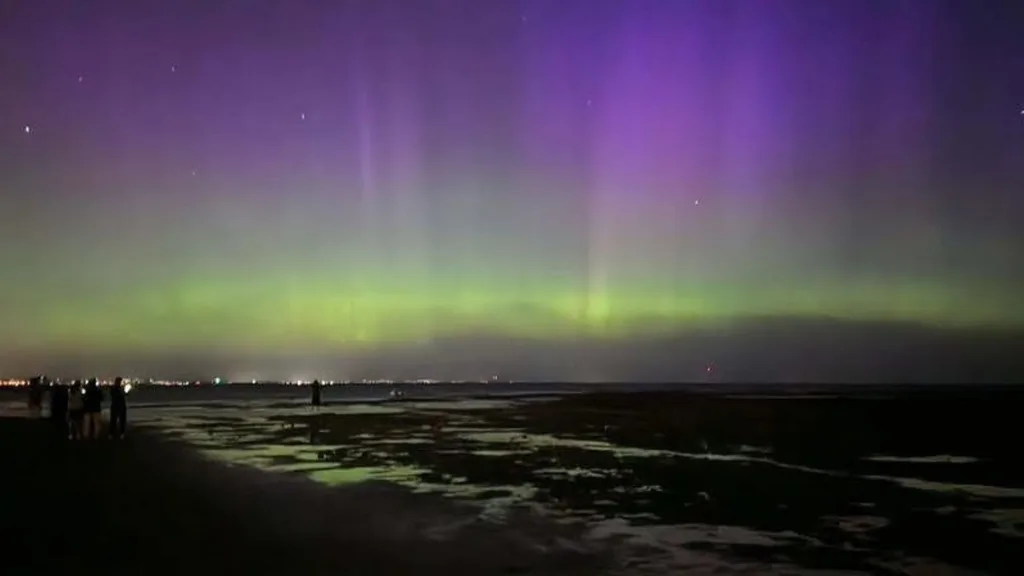
Dr Brand offers practical advice for aspiring aurora chasers: “In the southern hemisphere, the further south you are, the better your chances of seeing an aurora. Spotting an aurora not only depends on the strength of the associated geomagnetic storm but also on viewing conditions such as cloud cover.”
She recommends that “ideal conditions would be facing southwards away from light pollution during a cloud-free night.” And here’s an insider tip: “A camera with a long exposure can often show the aurora when your eyes can’t see it.”
Dr. French echoes this advice, noting that during active periods, “just take out your phone, set a long exposure, take the photograph, and you’ll see those colours beginning to pop. The human eye is not great at seeing in the dark. When your eyes adjust at nighttime, your colour perception isn’t fantastic, but a camera will pick up those colours that your eye cannot.”
For Dr. French, who has witnessed auroras multiple times in his career as a solar astrophysicist, the experience never gets old. “To see firsthand the influence of something 93 million miles away happening above our heads is quite striking,” he reflects. “The aurora sends the message that Earth is not just an isolated bubble in space, but we live in a solar system. We live next to a star. I’ve seen the aurora many times now, and every time it’s different.”
So if you’re hoping to catch the next aurora display, keep your eyes on space weather alerts from the Bureau of Meteorology’s Australian Space Weather Forecasting Centre, head south, find dark skies, and look toward the southern horizon after sunset. The Sun is putting on a show, and it seems like this year we might all be invited.

Related stories

Native ad body.

Native ad body.




Native ad body.